
Bitcoin Will Bleed Against Ethereum

[ad_1]
matejmo/iStock via Getty Images
Introduction
This article focuses on the investment case of Ether (ETH-USD). Specifically, the three primary application areas of the Ethereum network, the problems and opportunities I see in them, and the macro On-Chain metrics of Ether.
The use cases of the Ethereum network have huge addressable markets, but many applications are still in their infancy and early adoption phases. The On-Chain metrics of Ether picture a bullish outlook for the following months. Recent price action was dictated by the overleveraged futures market, but Open Interest was flushed out recently. On-Chain metrics suggest a continuation of the bull market.
If readers want to learn about the basics of the Ethereum network, I suggest reading the Ethereum whitepaper first. More introductory readings are available on Ethereum.org and Vitalik Buterin’s Website. A great economic introduction to Ethereum is the Seeking Alpha article from Lyn Alden Schwartzer, published earlier this year.
If there is enough reader interest, I may start a series of articles exploring and assessing some of the developments of the Ethereum Network more specifically. Let me know in the comment section.
Ethereum in a Nutshell
The Ethereum network is trying to evolve to a decentralized world computer. The network created Ether as a native cryptocurrency to access its smart contracts. Smart contracts are computer protocols that autonomously facilitate the execution of an agreement. These agreements can be anything imaginable, fitting in a conditional instruction (if, then, else).
Bitcoin (BTC-USD) does one thing very well: Storing and settling value. Second layer solutions could provide more complex operations to the Bitcoin network, but the base layer is simplistic and secure. The Ethereum Network applies a broader scale of technology within the base layer of the blockchain. The network is experiencing rapid changes. Thus, an investment in Ether is riskier than an investment in Bitcoin but provides significantly more upside.
The broad scale of the Ethereum network could capture much of the decentralized Web 3.0 value. Web 3.0 is enormously hyped at the moment and years away from being implemented in the real world. Nobody knows how this space will develop or which use cases will emerge.
Currently, the Ethereum network is primarily used for decentralized finance (DeFi), non-fungible tokens (NFTs), and decentralized autonomous organizations (DAOs).
Decentralized Finance
DeFi is a collective term for decentralized financial products and services. The segment has various advantages compared to the traditional banking system: The products and services are accessible to anyone with an internet connection. Markets are open 24/7, and there is (theoretically) no need for centralized authorities. Each market participant is responsible for their own money and controls how it’s spent. Transactions are completely transparent, but the underlying identities are pseudonymous. Transfers of funds are irreversible and settle within minutes.
DeFi can be separated into five segments: 1. Payments (Stablecoins), 2. Lending & Borrowing (Decentralized Lending), 3. Exchanging & Trading (DEXs), 4. Investing (STOs & ICOs) and 5. Store of Value (PoS/PoW). The sum of these segments could potentially lead to a decentralized banking system of the internet which could take over the traditional banking system and the coexisting fintech business. In 2021, the Gross value locked by Ethereum DeFi applications increased by 1.600%. But the huge addressable market doesn’t come without great risks and downsides.
DeFi needs significant improvements. Many services are still in their infancy and risky to use. There are regular reports about hacks and bug exploits of decentralized applications. The interface and general usability of most DeFi applications are terrible and not suited for broad adoption yet. As of now, the DeFi space provides a banking system of tokens to transfer tokens. There is not much value creation behind all this, and speculation remains the primary driving force of the segment. The DeFi segment is the wild west of the crypto asset space. There are many scams, almost no regulations, and high levels of uncertainty and emotionality.
The service providers of DeFi applications are often blamed for being centralized entities. I believe this criticism is misleading. Decentralization has the advantage of enabling full transparency and independence from centralized entities. However, decentralization also has one huge disadvantage: Transactions are irreversible, and thus market participants have to take responsibility for themselves. There is no bank support to reach out to if something goes wrong. When people transfer their Ether to a wallet of a scammer, who promises that they will double their coins the next day, their Ether is gone forever. If mass adoption is the final goal, centralized entities which provide decentralized services for their customers are needed as a rail system because human errors are inevitable.
Combining the benefits of a decentralized base layer and regulated centralized service providers will unlock the full potential of DeFi. The segment needs additional development and intense regulatory scrutiny to materialize its potential.
Non-Fungible Tokens
An NFT is a unique token stored on a blockchain. Opposed to Ether or Bitcoin, NFTs lack interchangeability. A holder of Ether couldn’t care less about which exact ETH his wallet is storing. The same goes for an investor and his ordinary shares of a company. However, a real estate owner cares about which property he owns because of its non-fungibility. NFTs are similar. They provide a certificate of authenticity or proof of ownership of a unique thing.
Currently, NFTs are used for digital content, gaming items, domain names, and digital investments. But a decentralized way of providing proof of ownership could be implemented in the real world as well. Notarial deeds could be replaced by the tokenization of real estate. The Ethereum wallet could become the key to homes, cars, and other physical items. That could simplify the bureaucratic standards of providing proof of ownership in today’s world. NFTs could create easy ways to provide secure signatures or tickets to real-world events.
At this early stage, NFTs are largely associated with artworks. Artists create digital art and sell it on some platform for insane amounts of money. The speculative DeFi characteristics dominate the NFT space as well. Speculators buy tokenized art to sell it for a profit in the future. In 2021, the market has reached complete bubble territory. The NFT market cap on Ethereum increased 16.600% YoY. These growth rates are not sustainable. I’m convinced that the current NFT market will come crashing down, the second crypto assets enter another bear market, similar to the big crypto ICOs in 2017.
NFTs have real-world use cases, even more digital use cases, and the addressable market is huge. Similar to most DeFi applications, the current market revolves around NFTs being created solely to trade NFTs. The current NFT market resembles market participants playing hot potato.
Decentralized Autonomous Organizations
DAOs are collectively owned and managed by internet organizations. Based on smart contracts, the rules of the organization are established and accessible to everyone. DAOs are funded by distributing native tokens. Voting rights and potential profits are usually distributed based on token ownership. After the funding phase, the DAOs function is autonomous. Financial transactions are recorded on the blockchain. Thus, DAOs are fully transparent, immutable, and incorruptible. You can think of a DAO as a decentralized company with flat hierarchies. Major decisions (= changes in the code) are voted on. Services are handled automatically in a decentralized manner, and spending of financial resources requires consensus.
Some examples of popular DAOs: Digix Global: A DAO managing DGX, an asset-backed token backed by physically stored gold. Bitshares: A DAO running Bitshares.org, which is a decentralized crypto exchange. MolochDAO: A DAO with the goal of funding Ethereum 2.0 development. Many more DAOs are closely connected to DeFi projects or serve funding purposes.
DAOs have the potential of establishing new ways to form companies. Missing hierarchical structures could lead to new innovative ideas because each member’s contribution counts and the best ideas are filtered out. There are low chances of corruption because each participant knows the predefined rules, and changes have to be confirmed by the network.
But DAOs are still in an early and shaky stage. They have a history of faulty source coding, resulting in exploit opportunities. The DAO hack in 2017 was the most prominent. A participant discovered a loophole that led to a withdrawal of 3,6 million Ether of the DAO via double-spending exploits. The Ethereum network reversed the transacted coins through a hard fork. Ethereum Classic (ETC-USD) emerged as the protocol which didn’t reset the exploited coin transactions. But the old network quickly lost significance.
The Bottom Line
I believe there is significant potential for value creation on the Ethereum network. Network participants are exploring different use cases like DeFi applications, NFTs, and DAOs. Especially the NFT space seems very bloated right now. Many projects seem to add no value to the ecosystem, but some will. The volatility is here to stay as the development continues, and many of today’s applications will disappear forever.
By holding Ether, market participants invest in the rail system of all current use cases and future use cases which will emerge on the Ethereum network. In the long-term (5+ years), Ether could flip Bitcoin in market cap due to its superior variety of potential use cases. However, the current use cases have not developed into broad adoption and remain highly speculative.
On-Chain Metrics Reveal the Macro Picture
The crypto asset market is driven by sentiment and speculators over the short- and medium-term. After the recent sell-off initiated by the overleveraged futures market, the macro picture came out of focus. I regard On-Chain metrics as a great tool for estimating long-term supply and demand trends.
The Recent Futures Market Flush Out:
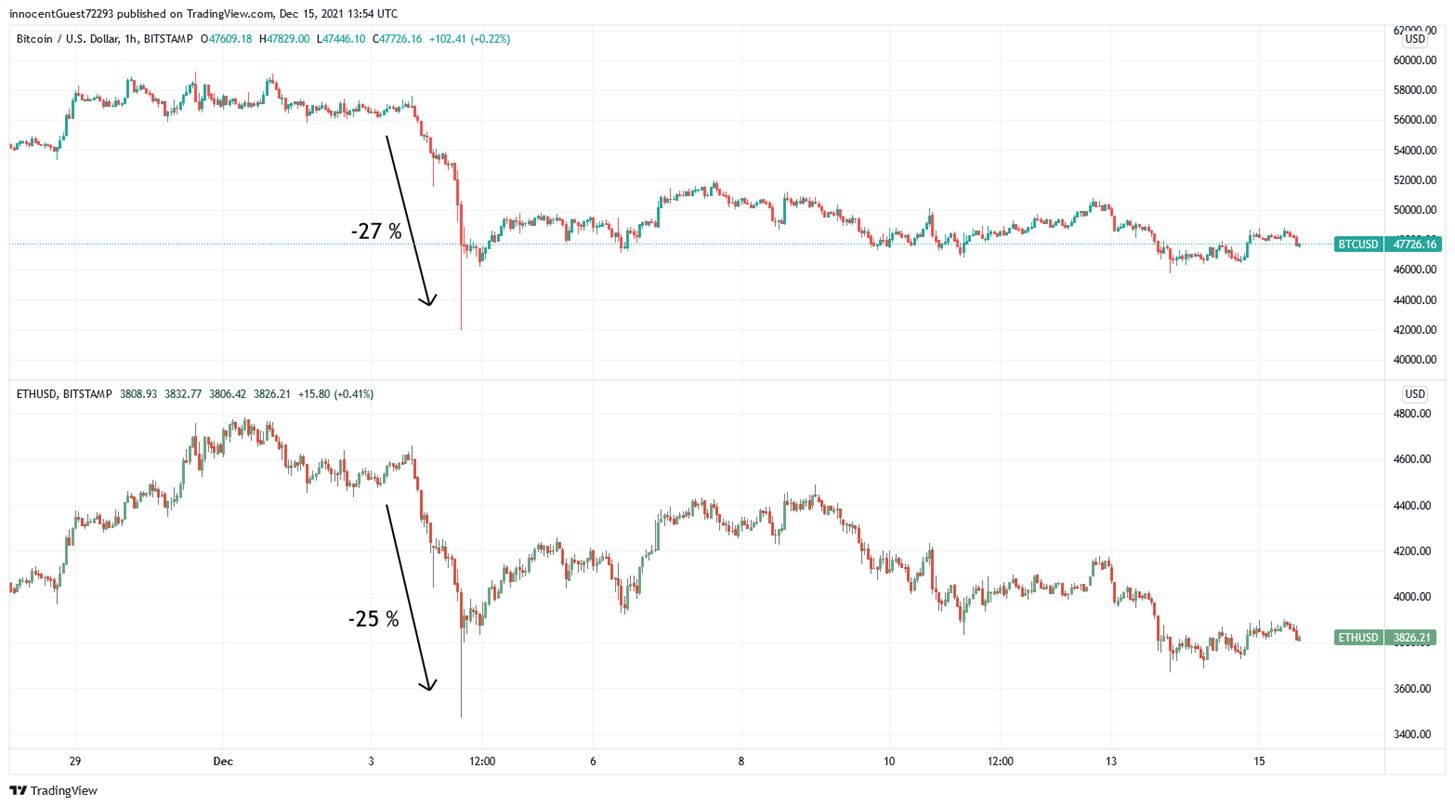
On December 03, Bitcoin and Ether crashed ~27% and ~25%.
Source: Image created by author using tradingview.com
After the cascade, Bitcoin and Ether prices recovered quickly. Bitcoin climbed from $42,000 to $50,000 within two days. Ether rose from $3,500 to $4,300 during the same period.
As I pointed out in my last article, the Bitcoin Futures Open Interest before the crash was at an all-time high with ~400,000 Bitcoin in total volume. While the Bitcoin price declined, open interest stayed the same. That caused a liquidation cascade. Futures open interest fell by ~60,000 Bitcoin to ~340,000 Bitcoin.
Ether had a similar liquidation event. The Ethereum Futures Open Interest before the crash reached ~2,000,000 Ether in total volume. After the liquidation cascade, Futures open interest fell by ~240,000 Ether to ~1,710,000 Ether.
The flush out was of significant scale and liquidated a large number of short-term traders or leveraged holders. Now there is less risk of leverage liquidations as the market cooled off. I believe in the following months the spot market will have an increased influence on the prices if Futures Open Interest remains at average levels.
Exchange Reserves are at Low Levels
Exchange Reserves of Ether decreased from 23,3 million Ether to 17,9 million Ether YTD. During the recent flush out, exchange reserves largely stayed the same. The latest price action happened mostly off-chain rather than on-chain.
Because of Ethereum’s upgrade from PoW to PoS, many holders of Ether are staking their coins before the update goes live. The ETH 2 staking rate (click “view all charts” to make the link work) reached 7.24% and steadily increases. Currently, already staked coins can’t be sold until the merge upgrade is implemented. That is one of the reasons, exchange reserves of Ether dropped more significantly than the exchange reserves of Bitcoin.
Staked coins will be illiquid until Q1/Q2 2022. When the staked reserves become liquid, there will be some price pressure as holders sell their previously locked-up Ether. However, depending on the staking rewards, some percentage of the supply will be staked by their holders in the long-term, reducing liquid supply permanently.
EIP 1559 made Ether less inflationary
The Ethereum network implemented the London Update in August 2021. Besides improving the network, the future issuance of new coins slowed because of EIP 1559. The Update changed how transaction fees are calculated. Until recently, the gas fees were solely auction-based. After EIP 1559, the gas fees are now based on a fixed fee with the option to tip miners. Additionally, the miners are rewarded with newly issued Ether, and a portion of the new fees are burned.
Since then, burned gas fees resulted in a significant reduction of the supply increase of Ether. EIP 1559 decreased the annual inflation rate of Ether from ~4% to ~3%. However, the monetary policy of Ether changed several times in the past and will most likely change in the future as well.
Ether outperforms Bitcoin during Bull Runs
Source: Ethereum/Bitcoin ratio created by author using tradingview.com
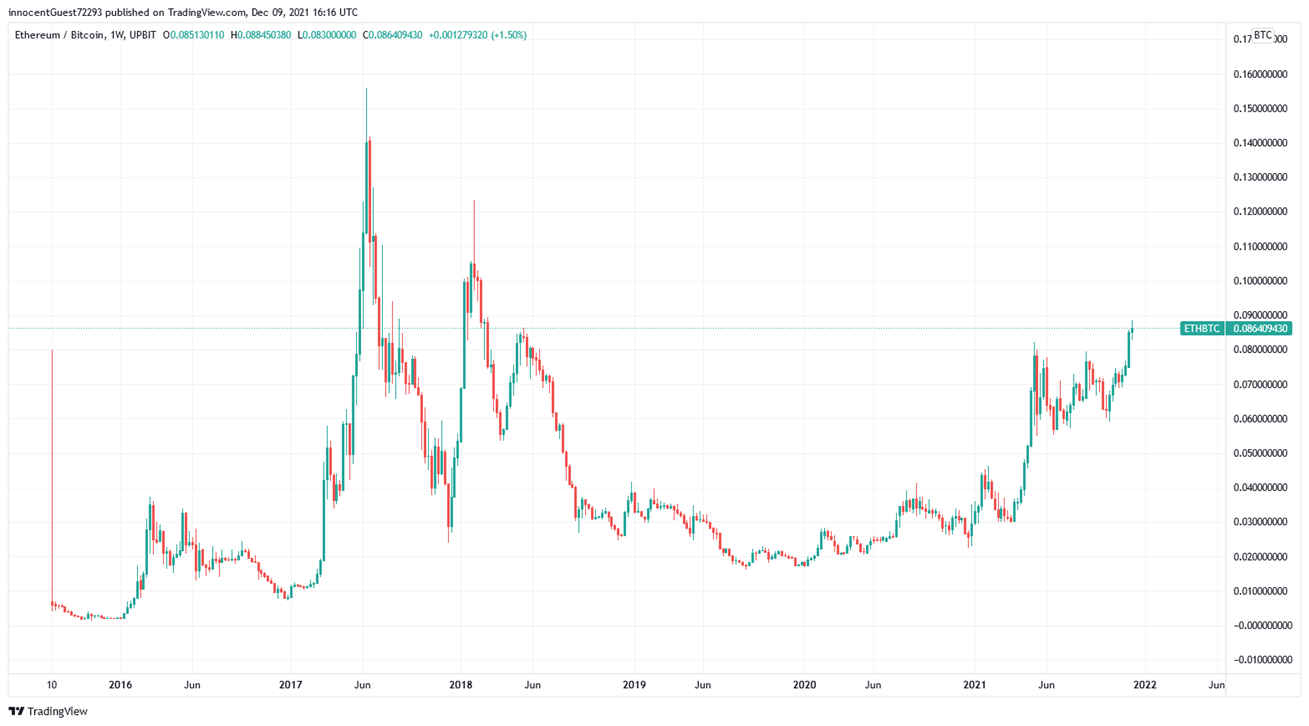
After the ERA 3 Cycle, which ended in early 2018, crypto assets entered their last bear market. Ether has underperformed Bitcoin during that time, while most other (more centralized) coins vanished completely. Since the bottom of the bear market in early 2020, Ether has constantly outperformed Bitcoin.
Playing the Risk Curve
I believe Ether has the best risk/reward ratio of all crypto assets at the moment. Because the Ethereum network keeps on changing, Ether is riskier than Bitcoin, and the appreciation in a bull market will be superior. Ethereum was launched in 2015, survived a bear market, remains rather decentralized, and serves as the execution layer for most decentralized applications. The probability of the Ethereum network failing because of another bear market is not comparable with other L1 blockchains (except Bitcoin, of course).
If the Bitcoin rally continues after a big sideways trend in 2021, Ethereum will outperform significantly. Previous cycles always ended with speculation manias, and I believe there is a chance that it will happen again. In retrospect, the bullish consensus of Q4/2021 was too unanimous for the market to rally. That changed now.
Lower inflation rates and growing staking rates already drained Ether exchange supplies. Even the recent flush out didn’t increase the total supply of Ether on crypto exchanges. These unique supply removal mechanics make Ether the best risk/reward bet if you believe this bull cycle will continue in 2022.
[ad_2]
Source link

